Research

Research Highlights

Highlights of research by the Robotics Institute. Each highlight brings together related videos, articles, papers and awards.

2026.10

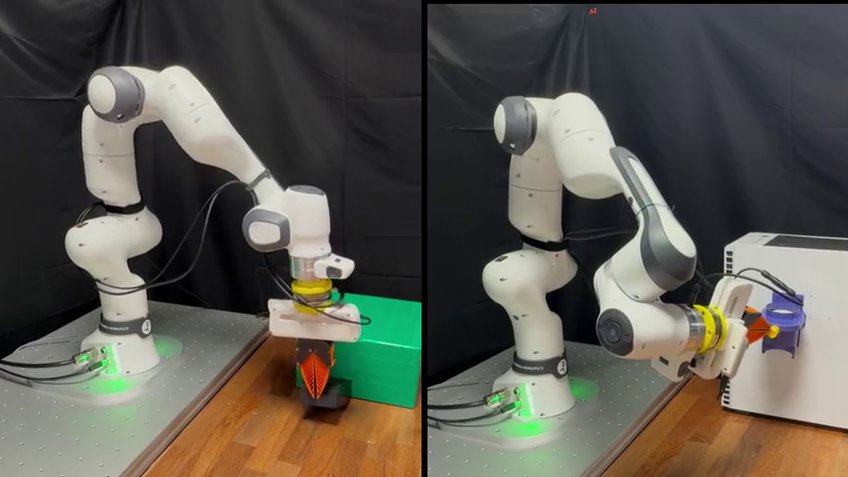
Constraint-Decomposed Impedance Control from Generative Policy for Articulated Object Manipulation

The method reads the spread of trajectories that a generative policy produces from the same observation to estimate which motions an articulated object (door, drawer, bolt) allows, then sets impedance gains that are stiff along those directions and compliant along constrained ones. In simulation and real-robot tests it reduced constraint-violating contact loads compared with isotropic impedance control; the paper was selected as a CoRL 2026 Spotlight.

Robotics & Automation Laboratory

2026.10

PathLift: Depth-Conditioned Metric Lifting for Visual-Navigation Priors

An adapter that turns the unitless paths output by pretrained visual-navigation policies into metric paths, correcting each waypoint with depth from RGB-D, stereo or LiDAR. It raised the navigation success rate of four navigation policies in simulation and on a real wheeled robot.

Robot Vision Laboratory

2026.10

Automated CT-based quantification of knee osteophytes for robotic-assisted total knee arthroplasty: a multi-cohort study

Using 387 knee CT scans, the team developed a 3D U-Net that automatically segments osteophytes and measures their volume on the preoperative CT acquired for planning robotic-assisted total knee arthroplasty. Against blinded expert-consensus annotations in two independent external cohorts (100 knees each), the median Dice coefficient was 0.913 and 0.909, and in a prospective cohort of 66 robotic-assisted surgeries the CT-derived volume showed cohort-level agreement with the volume of osteophytes actually resected (ICC 0.876).

Department of Orthopedic Surgery, Seoul National University Hospital

2026.09

CompVLA: A Variable Compliance Vision-Language-Action Model for Contact-rich Manipulation

A vision-language-action (VLA) model that predicts motion together with a time-varying stiffness from RGB images and language instructions, executed through geometric impedance control. It achieved a higher average success rate across several contact-rich manipulation tasks than vanilla and compliance-aware VLA baselines.

Robotics & Automation Laboratory

2026.07

OmniDS: Dual-Stream Context Fusion for Omnidirectional Depth from Fisheye Cameras

A method for 360-degree depth from multi-fisheye camera rigs that handles view-dependent visibility conflicts with a dual-stream (geometric and semantic) encoder and a multi-view consensus volume. It achieved state-of-the-art results on the OmniThings, OmniHouse and Sunny benchmarks.

Robot Vision Laboratory

2026.06

GaRLILEO: Gravity-aligned Radar-Leg-Inertial Enhanced Odometry

An odometry framework for legged robots that builds a continuous-time ego-velocity spline from radar Doppler and leg kinematics and estimates the gravity direction, reducing vertical drift without relying on LiDAR or cameras. On a self-collected indoor-outdoor dataset it was most accurate in vertical odometry on stairs and slopes, and both the dataset and the algorithm are open-sourced. The work was done with the Robotics and AI Institute (RAI).

RPM Robotics Lab

2026.06

Viola seed pod architecture shapes sequential, force-augmented pinching

Through biological and mathematical analysis, the team showed how a drying violet seed pod closes in sequence like a zipper, pinching out its seeds one at a time with consistent force. They applied this design principle to build autonomous zipping actuators and pointed to uses that include biomedical soft machines. The work was done with Prof. Youbong Hyun (SNU Biological Sciences) and Prof. Sohyun Jung (DGIST).

Micro Fluids & Soft Matter Laboratory

2026.05

De novo design of DNA origami with a generative diffusion model

The lab developed a diffusion-based generative framework that produces DNA origami designs for user-defined target shapes. It addresses the lack of experimental datasets by training on equilibrium conformations simulated with a multiscale computational model; from more than 100 generated candidates, selected structures were fabricated and their folding and function confirmed experimentally.

AI-driven Simulation and Design Lab

2026.05

Translytical Processing via DB-OS Co-designed Buffer: Cross-Engine Isolation and Tunable Update Visibility for HTAP

The lab presented Vista, a DB-OS co-designed buffer virtualization framework that reduces interference when a transactional (OLTP) engine and an analytical (OLAP) engine work on the same data on one node. Memory segments used by transactions are periodically sealed and remapped read-only into the analytical engine, physically isolating the two while keeping the lag before fresh updates become visible bounded and tunable. Implemented in PostgreSQL and integrated with DuckDB, it achieved up to 12.8x speedup over state-of-the-art baselines.

DBX Lab

2026.04

Personalized Digital Care Program Allocation for Older Adults: Reinforcement Learning-Based Simulation Study

The team proposed a reinforcement-learning model (contextual bandits with Thompson Sampling) that assigns digital care programs within an AI care call service according to each older adult's characteristics and changing needs. In simulations on two datasets it raised call success rates by 84.2% and 54.4% and lowered PHQ-2 depression scores by 32.1% and 41.4% compared with systematic allocation.

Aging Health Policy & Systems Research Lab (AgeLab)

2026.04

From Ballpark to Society: Understanding Stakeholders’ Adaptation to Automated Judgment via ABS in Baseball

Taking the Korea Baseball Organization's league-wide Automated Ball-Strike System (ABS) as a case, the team interviewed 38 stakeholders (umpires, players, coaches and fans) about adapting to an AI adjudicator. Acceptance depended less on accuracy than on verifiable consistency, while adaptive burdens were redistributed: players had to recalibrate strategies and umpires faced diminished authority. The paper proposes governance principles centred on transparency and adaptive role reconfiguration.

Data Intelligence and Learning Lab

2025.12

PanoGrounder: Bridging 2D and 3D with Panoramic Scene Representations for VLM-based 3D Visual Grounding

Renders 3D scenes as panoramas and feeds them to pretrained 2D vision-language models to locate the 3D object described by a text query. It reached state-of-the-art results on ScanRefer and Nr3D.

Robot Vision Laboratory

2025.11

Foldable and rollable interlaced structure for deployable robotic systems

The lab developed a deployable robotic structure (FoRoGated-Structure) that combines origami corrugation with interlacing, so it can be folded and rolled up like a tape measure for compact storage and becomes stiff enough to carry heavy loads when deployed.

BioRobotics Laboratory

2025.08

ScrewSplat: An End-to-End Method for Articulated Object Recognition

Recovers both the 3D geometry and the joint structure (screw axes) of articulated objects from RGB images alone by combining 3D Gaussian Splatting with screw theory. The recovered kinematic model, paired with a large vision-language model, was also used to demonstrate text-guided robot manipulation; the paper was an oral presentation at CoRL 2025.

Robotics & Automation Laboratory

2025.07

MOANA: Multi-Radar Dataset for Maritime Odometry and Autonomous Navigation Application

A maritime sensor dataset that combines long-range X-band radar, W-band radar suited to near-field tasks such as berthing, and short-range LiDAR in one framework. It provides seven sequences from regions of varying difficulty, with labels for objects at sea, and is released for research on place recognition, odometry, SLAM and object detection.

RPM Robotics Lab

2025.07

Reliable Tissue Grasping in Robotic Minimally Invasive Surgery Enabled by Optical-Based Slip Sensing

In robotic minimally invasive surgery, grasping tissue too hard damages it and grasping too lightly lets it slip. The lab developed an optical slip sensor that estimates slip displacement, direction and speed, detecting slip across speeds of 0.3–104 mm/s with a response time under 30 ms. Integrated into a da Vinci surgical grasper and tested on ex vivo porcine tissue, paired sensors could distinguish translational slip, rotational slip and tissue stretch.

Healthcare Robotics Lab

2025.06

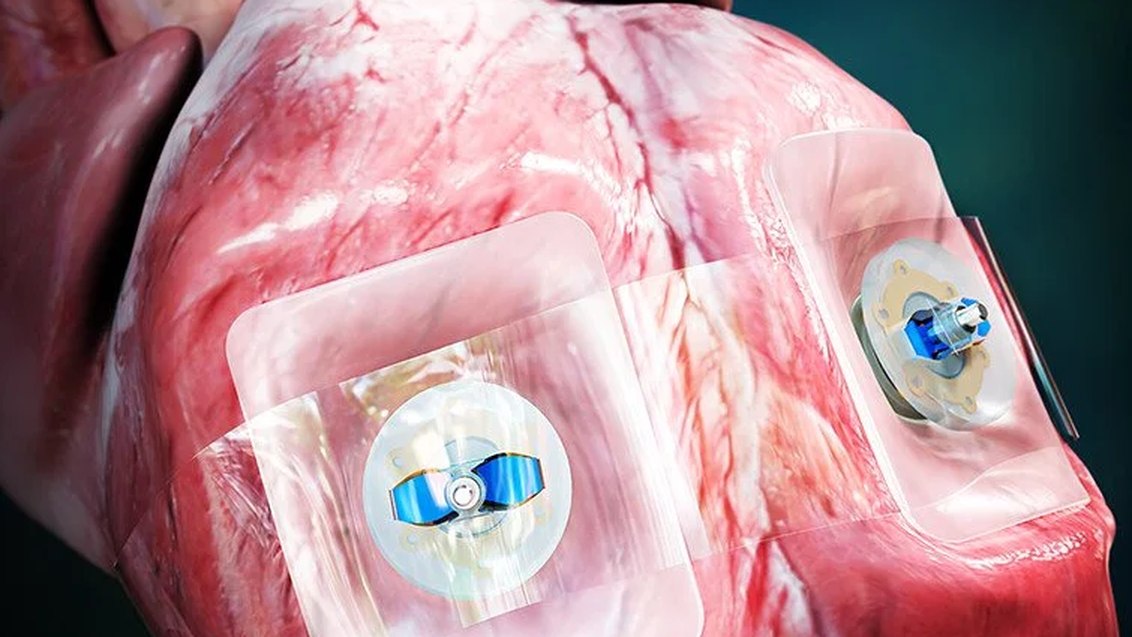
E-CAD: Electroactive Polymer-Based Cardiac Assist Device with Low Power Consumption

The lab developed E-CAD, a cardiac assist device weighing under 60 g that mounts electroactive polymer (EAP) actuators on a flexible sleeve wrapped around the heart and assists its compression without contacting blood. In tests with a silicone phantom and ex vivo porcine hearts it increased volume displacement 1.21-fold and 1.17-fold, respectively, while running on less than 0.3 W. The paper was selected as an inside front cover of Advanced Intelligent Systems.

Healthcare Robotics Lab

2025.05

Go-RIO: Ground-Optimized 4D Radar-Inertial Odometry via Continuous Velocity Integration using Gaussian Process

A radar-inertial odometry method that models the ground from noisy 4D radar returns zone by zone with uncertainty, and fuses radar velocity with IMU measurements in continuous time using Gaussian processes. It kept vertical drift below 1% on public datasets and was a finalist for the ICRA 2025 Best Paper Award.

RPM Robotics Lab

2025.03

Particle-armored liquid robots

The team made a millimetre-scale liquid robot (PB): a liquid blob densely coated with superhydrophobic particles, which makes it robust yet highly deformable. Experiments showed it passing through obstacles, engulfing and transporting cargo, and merging with other robots, and the paper gives a theoretical framework that predicts its shape evolution and dynamics.

Micro Fluids & Soft Matter Laboratory

2025.02

SCS: Superior-Vena-Cava Compressing Shape-Memory-Alloy-Based Implantable Device for Heart Failure

To relieve congestion in acute decompensated heart failure, the lab developed SCS, an implantable device driven by shape-memory-alloy (SMA) actuators that wraps around the superior vena cava and compresses it from outside to regulate blood flow, without direct blood contact. Benchtop tests showed a 68% decrease in flow rate, and in a porcine heart-failure model the left-ventricular end-diastolic volume fell by 18.6%. The paper was selected as a back cover of Advanced Engineering Materials.

Healthcare Robotics Lab

2025.02

Rapid Data Ingestion through DB-OS Co-design

The lab proposed zicIO, a database-operating system co-design that supports sequential ingestion of large tables from storage at full device speed. It prepares the required data just before the DBMS accesses it and avoids redundant fetching when several queries read the same table. Integrated with four databases, it improved performance by up to 9.95x under TPC-H loads.

DBX Lab

2025.02

Artificial Intelligence Research in Health and Care for Older Adults in Korea: A Scoping Review

A scoping review of 36 studies on artificial intelligence in health and care for older adults in Korea, grouped into intervention, acceptability and predictive-analysis studies. All intervention studies used robots and reported positive effects on depression and daily living ability but inconsistent results for cognitive function; the authors call for more diverse topics and stronger methods.

Aging Health Policy & Systems Research Lab (AgeLab)

2025.01

A hyperelastic torque-reversal mechanism for soft joints with compression-responsive transient bistability

The lab developed a hyperelastic torque-reversal mechanism (HeTRM) that stores elastic energy in a rubber-like soft joint and releases it at once past a threshold, letting soft robots make fast, strong motions.

BioRobotics Laboratory

2025.01

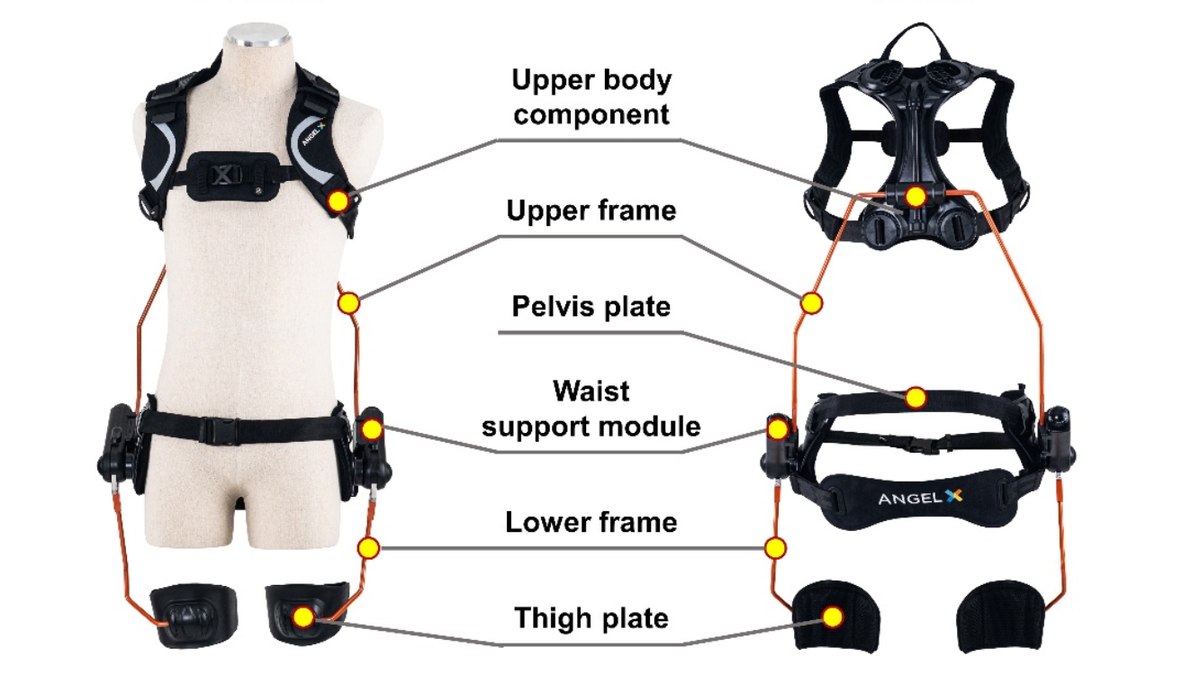
A comprehensive assessment of a passive back support exoskeleton for load handling assistance

The study evaluated a newly developed passive back-support exoskeleton for workers who handle heavy loads, looking at muscle activation, muscle fatigue, energy expenditure and perceived discomfort together. In static holding and repetitive lifting tasks with fifteen healthy young men, wearing the exoskeleton reduced activation and fatigue in key muscles, cut energy expenditure by 13.6%, and lowered perceived exertion and local musculoskeletal discomfort by 14.7% and 30.5%.

Sports Engineering Lab

2024.12

MOGrip: Gripper for multiobject grasping in pick-and-place tasks using translational movements of fingers

The lab developed MOGrip, a gripper that, like a human hand, holds several objects in its palm at once and places them one by one where needed, which can cut transport time in pick-and-place tasks.

BioRobotics Laboratory

2024.12

SketcherX: AI-Driven Interactive Robotic drawing with Diffusion model and Vectorization Techniques

A portrait-drawing system built from two 6-axis robot arms: a 'face robot' with a camera and a large language model converses with the visitor, while a 'drawing robot' turns the face photo into pen strokes using a fine-tuned diffusion model and vectorization. The paper reports personalized portraits completed within two minutes; it was presented in the NeurIPS 2024 Creative AI track.

Machine Intelligence & Pattern Analysis Laboratory (MIPAL)

2024.11

T²SQNet: A Recognition Model for Manipulating Partially Observed Transparent Tableware Objects

A neural network that recognizes transparent tableware from partial-view RGB images, where depth sensing is unreliable, using an extended family of deformable superquadrics. With it, a robot sequentially grasped and cleared the tableware without re-recognition and retrieved initially non-graspable targets such as a wineglass.

Robotics & Automation Laboratory

2024.08

Selective reactivation of value- and place-dependent information during sharp-wave ripples in the intermediate and dorsal hippocampus

The lab recorded place cells in the dorsal and intermediate hippocampus while rats learned which arm of a T-maze held the higher-value reward. During sharp-wave ripples, intermediate-hippocampus cells representing the high-value location were reactivated significantly more often than those for the low-value location, whereas in the dorsal hippocampus the routes leading to high-value locations were replayed more. The results suggest how the hippocampus may optimize goal-directed spatial learning for maximal reward.

Laboratory for Behavioral Neurophysiology of Memory

2024.07

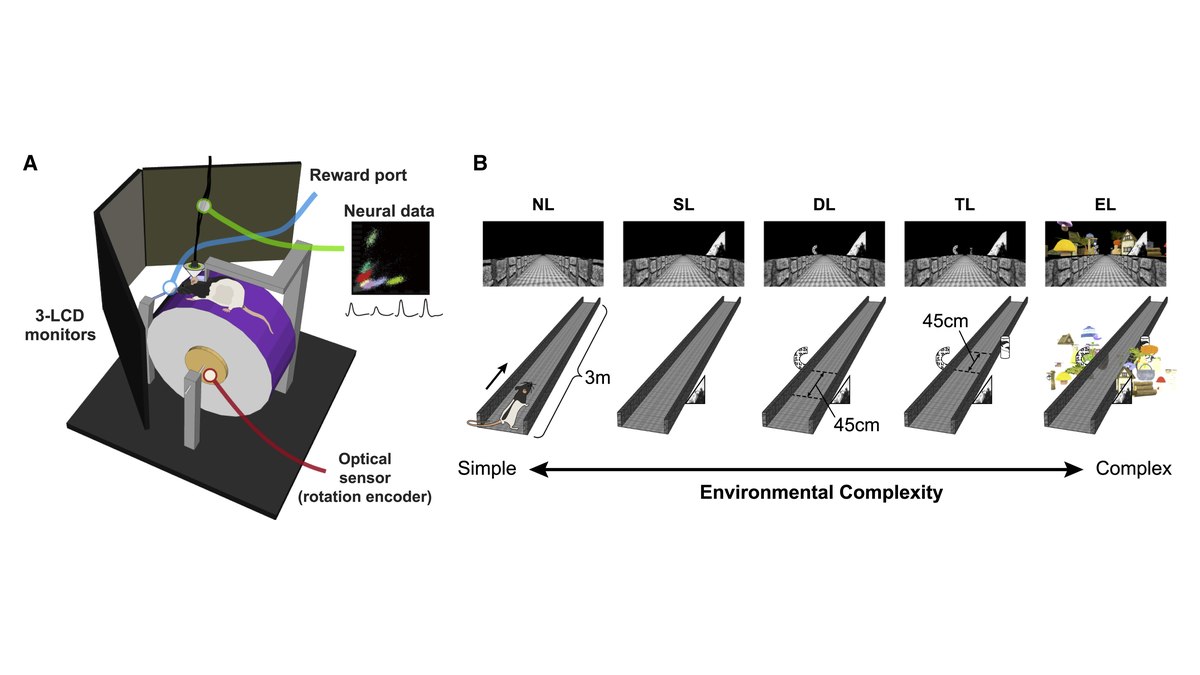
Differential functions of the dorsal and intermediate regions of the hippocampus for optimal goal-directed navigation in VR space

Rats on a spherical treadmill learned, in a visually rich virtual reality environment allowing two-dimensional navigation, to head for the reward zone with the higher reward. Temporarily inactivating either the dorsal or the intermediate hippocampus altered the efficiency and precision of wayfinding, but inactivating the intermediate hippocampus also impaired the preference for the higher-value place, suggesting that it is more critical for value-dependent, goal-directed navigation.

Laboratory for Behavioral Neurophysiology of Memory

2024.06

What, How, and When Should Object Detectors Update in Continually Changing Test Domains?

A test-time adaptation method that lets an object detector adapt online as the test environment keeps changing. It leaves the pretrained backbone untouched and updates only lightweight adaptor modules, and decides when further adaptation is needed. It improved mAP over baselines by up to 4.9%p on COCO to COCO-corrupted and 7.9%p on SHIFT while running at about 20 FPS or higher.

Machine Intelligence & Pattern Analysis Laboratory (MIPAL)
2024.05

3D printing with a 3D printed digital material filament for programming functional gradients

The lab developed a way to blend several materials into a single filament, like mixing paint, so that a simple low-cost FDM 3D printer can print multi-material parts with gradually varying properties.

BioRobotics Laboratory

2024.05

I feel being there, they feel being together: Exploring How Telepresence Robots Facilitate Long-Distance Family Communication

The team placed telepresence robots with eight long-distance families for two weeks and analyzed videos of their interactions and pre- and post-deployment interviews. Physical embodiment and autonomy enabled five kinds of family interaction: multi-party communication, exploring the home, restoring family routines, providing support and joint physical activities. The paper presents design guidelines for telepresence robots as family communication tools.

Human-Computer Interaction+Design Lab.

2024.03

Prediction of DNA origami shape using graph neural network

The lab built a graph neural network that rapidly predicts the three-dimensional shape of DNA origami assemblies. To make up for the scarcity of validated structural data, it is trained with both a data-driven loss and a physics-informed loss; the model was also applied to supramolecular assemblies of tens to hundreds of DNA blocks and to automated inverse design for given target shapes.

AI-driven Simulation and Design Lab

2023.07

Harnessing a paper-folding mechanism for reconfigurable DNA origami

The lab proposed a way to build DNA origami that folds and unfolds like paper: a flat DNA wireframe whose edges follow a paper-folding crease pattern, so that one structure can be folded into several target shapes. Folding and unfolding were driven repeatedly by DNA strand displacement, and the team also showed folding triggered by pH or light and folding-based microRNA detection. The paper appeared as a cover article in Nature.

AI-driven Simulation and Design Lab

2023.06

Bandit-supported care planning for older people with complex health and care needs

For nursing homes short of care workers, the team proposed an AI-assisted care planning model that uses bandit algorithms to optimize clinical decisions by learning from feedback on past decisions, so that residents can receive care suited to their individual needs. The model was evaluated on empirical data from the SPEC study, an ICT-enhanced care management program.

Aging Health Policy & Systems Research Lab (AgeLab)

2022.12

Subtle visual change in a virtual environment induces heterogeneous remapping systematically in CA1, but not CA3

The lab recorded place cells simultaneously from hippocampal CA1 and CA3 of rats in a virtual reality environment. When visual noise ('virtual fog') was added to a visually enriched environment, CA1 place cells split into one subpopulation that kept its field locations while changing firing rates and another that remapped globally, whereas CA3 cells showed mainly rate remapping. The results suggest CA1 may hold heterogeneous maps of the same environment at once.

Laboratory for Behavioral Neurophysiology of Memory

2022.08

Deep learning-based landmark recognition and angle measurement of full-leg plain radiographs can be adopted to assess lower extremity alignment

To assess lower-limb alignment, an essential step in diagnosing and treating knee osteoarthritis, the team built a deep-learning model from 11,212 full-leg radiographs that locates 15 anatomical landmarks and computes the alignment angles. Its measurements agreed with reference measurements by an orthopaedic specialist with 14 years of experience (inter-observer ICC of 0.98 or higher) and were identical on repeated measurement.

Department of Orthopedic Surgery, Seoul National University Hospital

2021.09

Part-Aware Data Augmentation for 3D Object Detection in Point Cloud

The lab proposed PA-AUG, a data augmentation method that divides each 3D object box in a LiDAR point cloud into parts and stochastically applies five augmentations (dropout, swap, mix, sparsify, noise) to each part. It improved a 3D object detector on all classes of the KITTI dataset, with an effect equivalent to about 2.5 times more training data, and the code is public.

Machine Intelligence & Pattern Analysis Laboratory (MIPAL)

2021.08

Body-powered variable impedance: An approach to augmenting humans with a passive device by reshaping lifting posture

A passive exo-suit, driven only by the wearer's own body motion and without motors, that guides the wearer into a safe lifting posture without bending at the waist and reduces the load on the lower back.

BioRobotics Laboratory

2021.04

High–load capacity origami transformable wheel

Working with Hankook Tire and others, the lab used origami principles to build a wheel that changes diameter with road conditions, from 46 cm on flat roads to 80 cm on rough terrain, and tested it on a one-ton vehicle. The paper was a Science Robotics cover article.

BioRobotics Laboratory

2021.02

Single EMG Sensor-Driven Robotic Glove Control for Reliable Augmentation of Power Grasping

The team developed a control method for a robotic glove that augments power grasping by reading the wearer's intent from a single EMG signal picked up near the wrist, at the junction of tendon and muscle. Unlike earlier approaches that needed several sensors on several muscles, one sensor is enough for intuitive control. The work was carried out with Prof. Kyu-Jin Cho's lab at SNU Mechanical Engineering, KAIST and Seoul National University Bundang Hospital.

Sports Engineering Lab

2020.04

Bot in the Bunch: Facilitating Group Chat Discussion by Improving Efficiency and Participation with a Chatbot

The team built GroupfeedBot, a facilitator chatbot that manages discussion time, encourages members to participate evenly and organizes opinions in group chats. In preliminary user studies across tasks and group sizes, groups with the chatbot showed more diverse opinions, and in medium-sized groups it promoted even participation and effective communication.

Human-Computer Interaction+Design Lab.

2020.04

Understanding User Perception of Automated News Generation System

The team designed NewsRobot, a research prototype that automatically generated real-time news on major events of the PyeongChang 2018 Winter Olympic Games, and studied 30 users through surveys and interviews. Users preferred individualized news yet considered it less credible, and saw the automated news as factual and accurate but shallow in depth.

Human-Computer Interaction+Design Lab.

2015.07

Jumping on water: Surface tension–dominated jumping of water striders and robotic insects

Together with Prof. Ho-Young Kim's lab, the team explained how water striders use surface tension to jump and built a 68 mg insect robot that jumps off water in the same way. The work was published in Science.

BioRobotics Laboratory · Micro Fluids & Soft Matter Laboratory

Go to the National Research Lab siteTC + PG · 78 faculty
Poster of the 2026 soft robotics training course on soft materials and actuation (in Korean)

2026 course on soft materials and actuation · 2026.10.28