
Kang, Seung-kyun
Dept. of Materials Science and Engineering Engineering
Bio-interface Electronics Laboratory ↗AffiliatedPG 3

 Human-Centered Physical AI Robotics InstituteSNU Robotics Institute · NRL 2.0
CEDCreative Engineering Design
National Research Lab
Human-Centered Physical AI Robotics Institute
The National Research Lab (NRL 2.0) is a program run jointly by the Ministry of Education and the Ministry of Science and ICT to foster university-affiliated research institutes. SNU Robotics Institute was selected for the program in 2026 and, with long-term support of up to ten years, carries out the project “Human-Centered Physical AI Robotics Institute.” The National Research Lab is a research program of the Robotics Institute, bringing together researchers from engineering, medicine, public health, brain and cognitive sciences, the social sciences and other fields.
Through this program, SNU Robotics Institute develops foundational technologies for human-centered physical AI by co-designing robot bodies and intelligence. Concentrating all decisions and control in a central AI creates challenges in computation, energy use and response time in complex real-world settings. The project combines embodied physical intelligence, in which materials, structures, contact and deformation contribute to computation and adaptation, with distributed intelligence, in which each part of the robot processes information, learns and cooperates with higher-level intelligence. The goal is to establish design, learning and control principles for robots that adapt to their environments and users.
Human-centered research addresses both robot capabilities and the conditions in which people use them. Safety, clinical reliability, user autonomy and social acceptance are considered and assessed from the design stage. Digital twins of robot–human–environment interactions complement physical experiments to evaluate performance and practical applicability.
The Technical Cores (TCs) develop foundational technologies shared across applications. The Project Groups (PGs) define use environments and research requirements, then apply and evaluate these technologies.
The program aims to apply shared foundational technologies in real use environments and feed the validation results back into technology development. So that research results do not stay in the lab, we are setting up shared research infrastructure for fabrication, data and computing, and pursuing a Lab-to-Market framework that links industry collaboration, technology commercialization and entrepreneurship.
National Research Lab
Research at the National Research Lab advances on two interlocking axes. The Technical Cores (TCs) develop shared foundational technologies, from the robot’s body and intelligence to digital twins and human values, while the Project Groups (PGs) take on human-centered applications such as everyday assistance, wearable robots and intra-body robots. The PGs pose the problems to be solved, and the TCs provide the technologies that solve them.
Research architecture
Every Project Group collaborates with all four Technical Cores. The table illustrates the overall research architecture rather than a fixed assignment of individual projects.
| Project Group ↓ · Technical Core → | TC 1MORPHI Body | TC 2MOSAIC Intelligence | TC 3Digital Twin | TC 4Human Value |
|---|---|---|---|---|
| PG 1Life Companion | Body AdaptationShape & Stiffness | Context UnderstandingIntent & Action | Living EnvironmentsVirtual & Physical Validation | Safety & AcceptanceEveryday Trust |
| PG 2Wearable | Body InterfacesFit & Actuation | Personal AdaptationMovement & Assistance | Human–Robot ModelsDesign & Evaluation | Human-centered DesignSafety & Usability |
| PG 3Intra-Body | Soft StructuresAdaptation to Confined Spaces | Precision ControlState & Action Coordination | Biological Environment ModelsClinical Validation | Clinical TrustRisk & Ethics |
PGs frame human-centered application challenges. TCs provide shared foundational technologies, from hardware to intelligence, validation and value criteria.
TC 01 · MORPHI Body
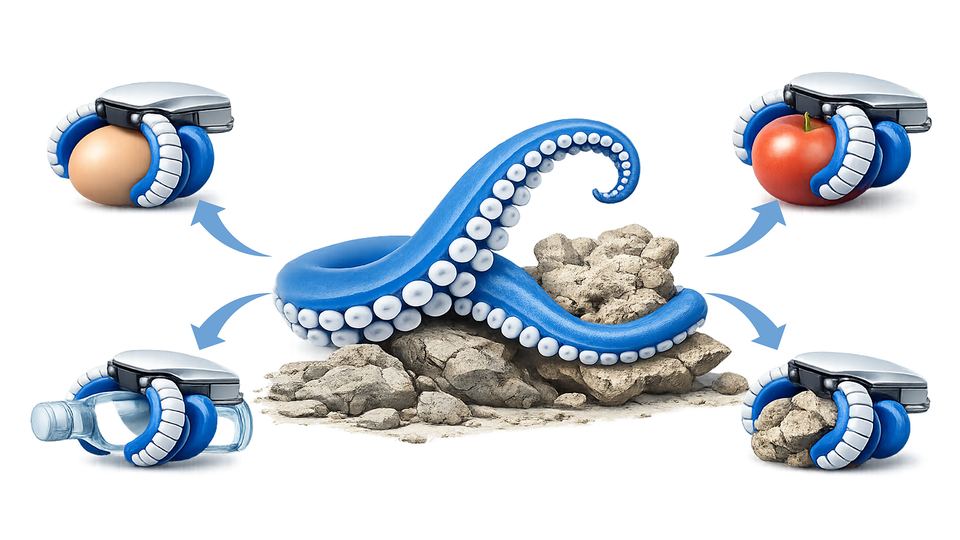
Robots that move in contact with people must respond safely to unpredictable changes. Handling every response through sensors and complex control algorithms increases computation and energy demand. This is why robots need materials and structures that themselves distribute forces and comply with their surroundings, going beyond the limits of a fixed body.
MORPHI Body combines physical intelligence with variable structures that change shape and stiffness to suit the environment. Mechanisms are designed to find balance and distribute forces, allowing the body itself to perform part of the computation and control. We also study how robots sense their own physical state and respond to bodily changes, aiming for safe interaction and affordable, energy-efficient hardware.
Leader Cho, Kyu-JinDeputy Leader Han, Kyungwon19 faculty
TC 02 · MOSAIC Intelligence
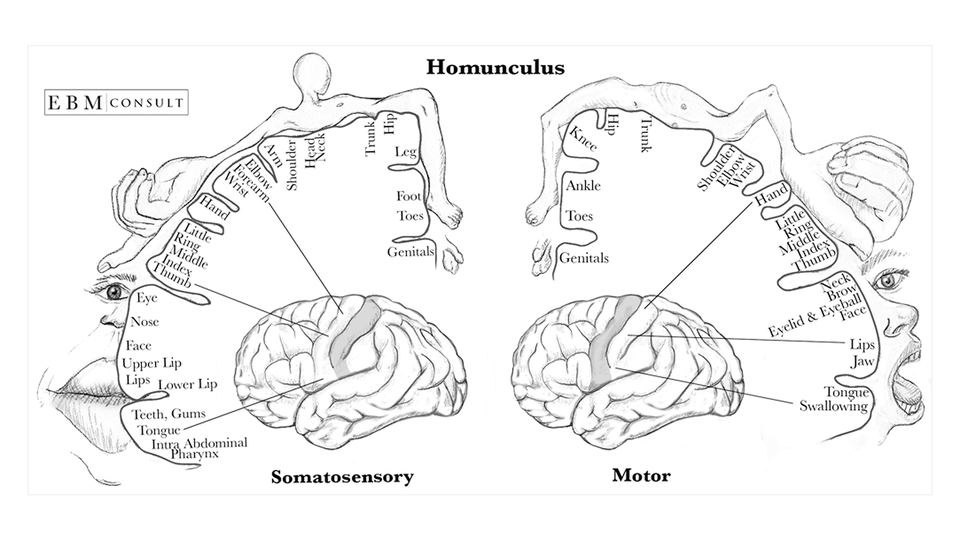
Retraining an entire intelligence system whenever a robot’s body or task environment changes demands substantial time and computing resources. Real-world settings also require immediate responses to contact with people and changes in task conditions. Robots therefore need an architecture that can learn and reconfigure individual functions while coordinating overall behavior.
Inspired by functional specialization and coordination in the brain, MOSAIC Intelligence studies an architecture in which a higher-level global intelligence coordinates local intelligence for each body part and function. Local modules learn physical interactions and movement, while global intelligence interprets situations and goals and coordinates their cooperation. We study module recomposition and continual learning across both levels to enable efficient adaptation to different bodies and tasks.
Leader Kwak, NojunLeader Lee, Inah29 faculty
TC 03 · Digital Twin
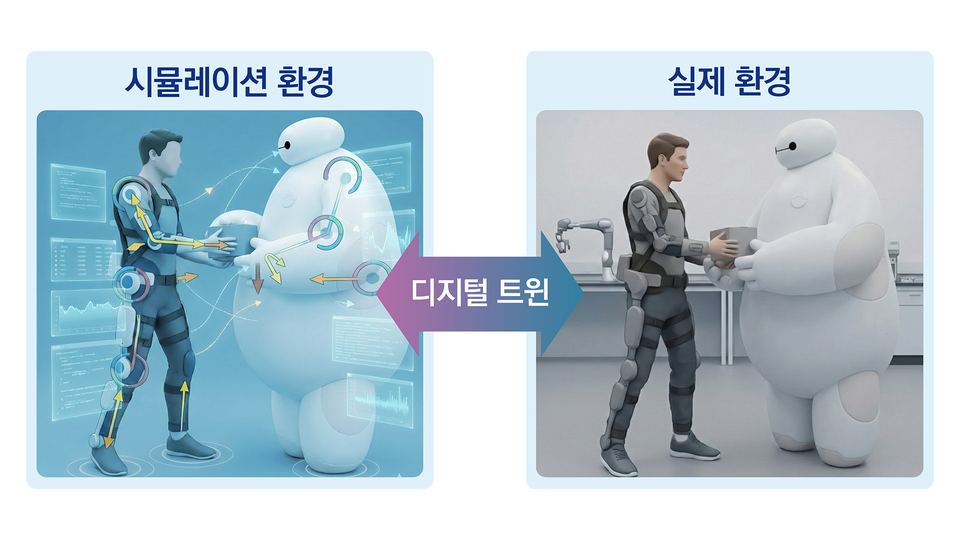
Predicting contact between people and robots in changing environments requires multiple physical phenomena to be considered together. Existing digital twins can be fragmented by phenomenon, or face a trade-off between prediction accuracy and computing speed. Faster robot design, learning and validation require accurate, rapid simulation of complex interactions alongside consistent management of diverse data.
The Robot–Human–Environment Digital Twin connects multiphysics simulation, a data fabric and integrated software–hardware optimization. We study how to generate and augment physically consistent data in virtual experiments and connect it with real-world observations for iterative robot design and validation. The aim is an integrated framework that supports everyday assistance, wearable and intra-body robots under their different operating conditions.
Leader Kim, Do-NyunDeputy Leader Jung, Hyungsoo19 faculty
TC 04 · Human Value
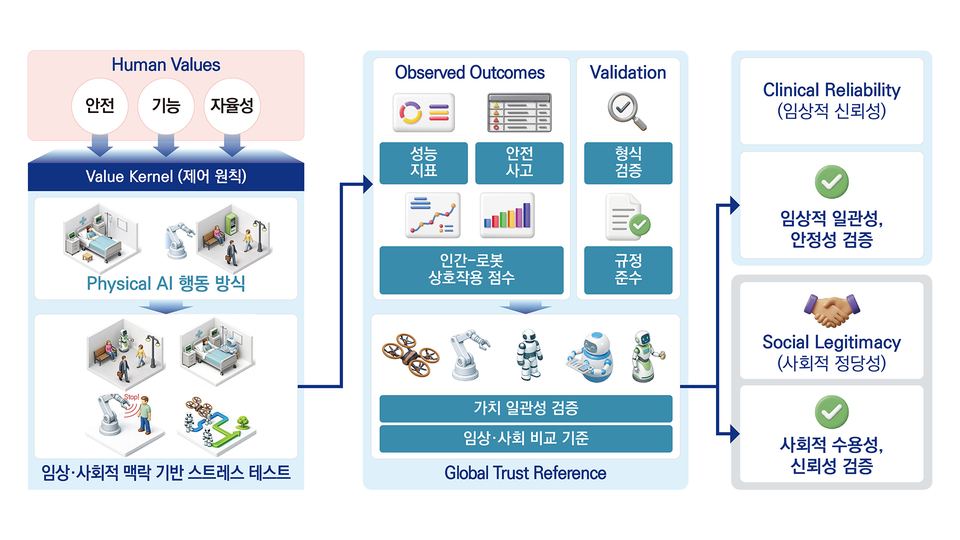
Higher performance alone does not make a robot beneficial or trustworthy. Robots that directly affect people’s bodies and daily lives must account for human values, including safety, functioning and autonomy. Rather than only evaluating ethics or usability after development is complete, a framework is needed that reflects and verifies these values from initial design through control and real-world validation.
Human Value studies a Value Operating System (Value OS) that translates human-centered values into design decisions and control principles that can be verified throughout development. Scenarios reflecting clinical and social contexts are used to examine robot behavior and risks to human values, with findings fed back into subsequent designs. The aim is to lay a foundation for comparing and judging robots’ clinical reliability and social acceptance against consistent criteria.
Leader Kim, HongsooDeputy Leader Park, Hyunwoo19 faculty
PG 01 · Life Companion
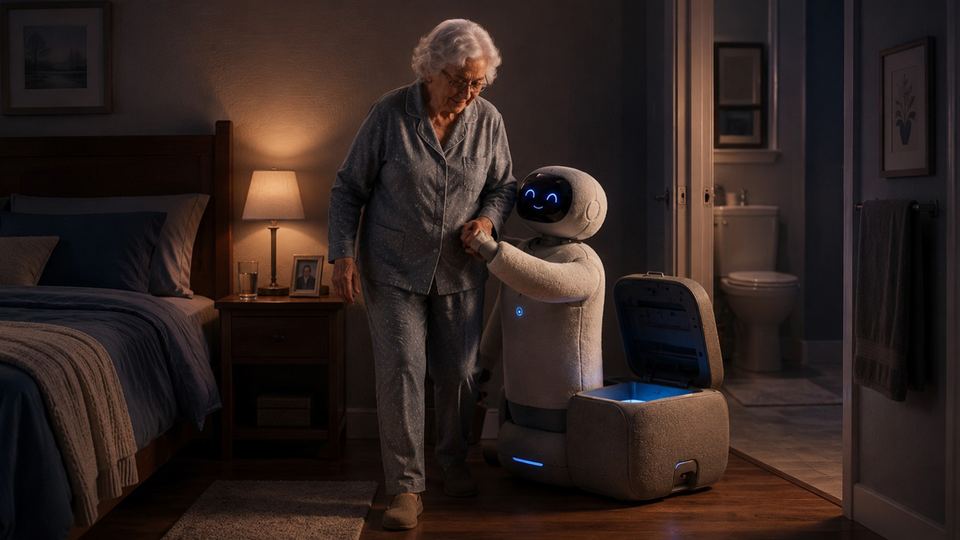
We study robots that understand human intentions and environmental changes, and share everyday tasks in open, unstructured settings such as homes and living spaces.
Leader Lee, JoonhwanDeputy Leader Cho, Kyu-Jin23 faculty
PG 02 · Wearable
Robots worn directly on the body support movement, strength and balance, providing a natural experience tailored to each person’s physical characteristics.

Leader Ahn, JooeunDeputy Leader Kim, Jinsoo21 faculty
PG 03 · Intra-Body
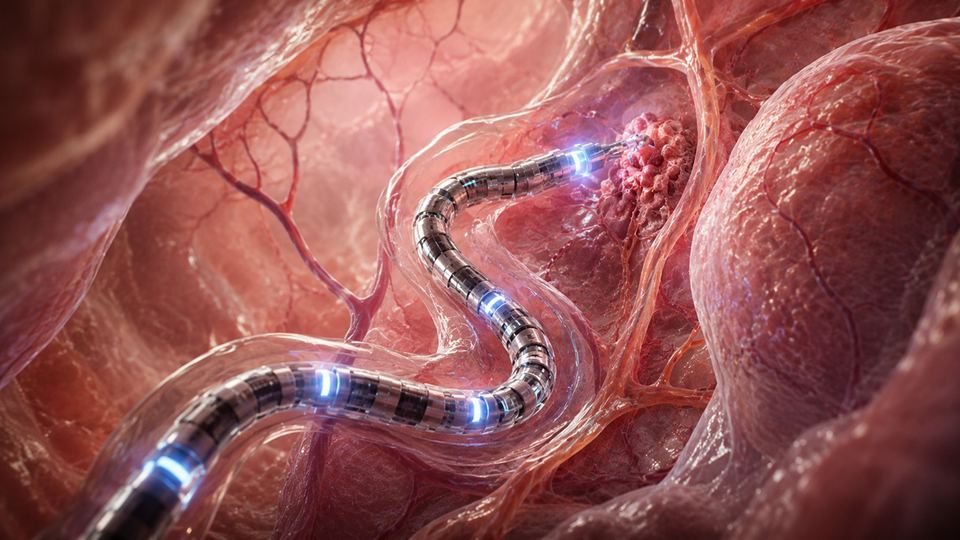
We develop robots and interfaces that operate in harmony with surrounding tissue in confined, sensitive internal environments, and build validation frameworks connected to clinical practice.
Leader Kim, Ho-YoungDeputy Leader Ro, Du Hyun19 faculty
National Research Lab
The faculty behind our NRL research · 78 faculty members from engineering, medicine, the natural sciences, the humanities and social sciences work together across the Technical Cores and Project Groups.
41 participating and 37 affiliated faculty members
Many faculty members belong to more than one group. Participating faculty carry out the NRL project directly; affiliated faculty take part through joint research in each group.
Dept. of Materials Science and Engineering Engineering
Bio-interface Electronics Laboratory ↗Dept. of Mechanical Engineering Engineering
Acoustics & Vibration Laboratory ↗

Dept. of Intelligence & Information AI & data
Machine Intelligence & Pattern Analysis Laboratory ↗


Dept. of Mechanical Engineering Engineering
Robot Perception & Spatial Intelligence Laboratory ↗
Dept. of Electrical & Computer Engineering Engineering
3D Visual Computing & Geometry Laboratory ↗
College of Medicine Medicine, nursing & public health
Biomedical Informatics Laboratory (SNUBI) ↗University of Illinois Overseas institutions
Kinetic Intelligent Machine Lab (KIMLAB) ↗

Graduate School of Data Science AI & data
Learning and Adaptation Algorithms Lab (LAAL) ↗Dept. of Mechanical Engineering Engineering
Nano Energy Transport and Engineering Laboratory ↗Dept. of Aerospace Engineering Engineering
Laboratory for Autonomous Robotics Research ↗

Graduate School of Public Health Medicine, nursing & public health
Aging Health Policy & Systems Research Lab (AgeLab) ↗
College of Medicine Medicine, nursing & public health
Inhee Mook-Jung Laboratory (Alzlab) ↗
School of Law Humanities, social sciences & education
Researcher website ↗
School of Transdisciplinary Innovations Engineering
BioMedical and Brain-Machine/Computer Interfaces Laboratory (B-MIL) ↗Dept. of Computer Science & Engineering Engineering
Visual & Geometric Intelligence Laboratory ↗
Dept. of Mechanical Engineering Engineering
Robotics & Automation Laboratory ↗Dept. of Textiles, Merchandising & Fashion Design Humanities, social sciences & education
Wearable Ergonomics & Anthropometrics Research Lab (W.E.A.R.) ↗

Dept. of Mechanical Engineering Engineering
Multiphase Flow & Flow Visualization Laboratory ↗Dept. of Aerospace Engineering Engineering
Space Mobility & Robotics Laboratory ↗
Dept. of Biological Sciences Natural sciences
Molecular & Cellular Genetics Laboratory ↗Dept. of Electrical & Computer Engineering Engineering
Electrical Engineering–Medicine Convergence Laboratory ↗
Dept. of Materials Science and Engineering Engineering
Multi-Functional Soft Materials Lab ↗Dept. of Mechanical Engineering Engineering
Innovative Design & Integrated Manufacturing Laboratory ↗
Dept. of Psychology Humanities, social sciences & education
Computational Clinical Science Laboratory ↗Dept. of Intelligence & Information AI & data
Scalable Computer Architecture Laboratory ↗
Dept. of Physical Education Humanities, social sciences & education
Sports Engineering Laboratory ↗Dept. of Civil & Environmental Engineering Engineering
Construction Engineering & Management Laboratory ↗

Dept. of Electrical & Computer Engineering Engineering
Robot Learning Laboratory ↗
School of Transdisciplinary Innovations Engineering
Physical & Interactive Intelligence Lab ↗
Dept. of Mechanical Engineering Engineering
Hyperautomation Artificial Intelligence Laboratory ↗Dept. of Biological Sciences Natural sciences
Center for Single Molecule Systems Biology ↗Dept. of Electrical & Computer Engineering Engineering
Computer Vision Laboratory ↗

Dept. of Mechanical Engineering Engineering
Interactive & Networked Robotics Laboratory (INROL) ↗Dept. of Psychology Humanities, social sciences & education
Memory and Cognition Laboratory ↗
Dept. of Mechanical Engineering Engineering
Energy Device & Nano-Engineering Laboratory ↗
Dept. of Brain & Cognitive Sciences Natural sciences
Learning & Memory Laboratory ↗Dept. of Computer Science & Engineering Engineering
Architecture and Code Optimization Lab ↗

Dept. of Communication Humanities, social sciences & education
Human-Computer Interaction+Design Lab ↗
Dept. of Computer Science & Engineering Engineering
Real-Time Ubiquitous Systems Laboratory ↗
Dept. of Mechanical Engineering Engineering
Advanced Manufacturing & Smart Materials Laboratory ↗

Dept. of Mechanical Engineering Engineering
Multiscale Biomedical Engineering Laboratory ↗
School of Transdisciplinary Innovations Engineering
Semiconductor Devices for AI Laboratory ↗


Dept. of Electrical & Computer Engineering Engineering
Machine Perception & Reasoning Laboratory ↗
Dept. of Electrical & Computer Engineering Engineering
Electric Energy Conversion Laboratory ↗


Dept. of Electrical & Computer Engineering Engineering
Advanced Flexible & Stretchable Electronics Laboratory ↗No results found.