
- 해동첨단공학관에서 열린 개소식… 국내외 인사 100여 명 참석
- ‘인간을 위한 로봇’ 철학으로 인간중심 피지컬 AI 10년 도전 선언
- “젊은 연구자들의 대담한 로봇 연구와 창업의 안전망이 될 것”
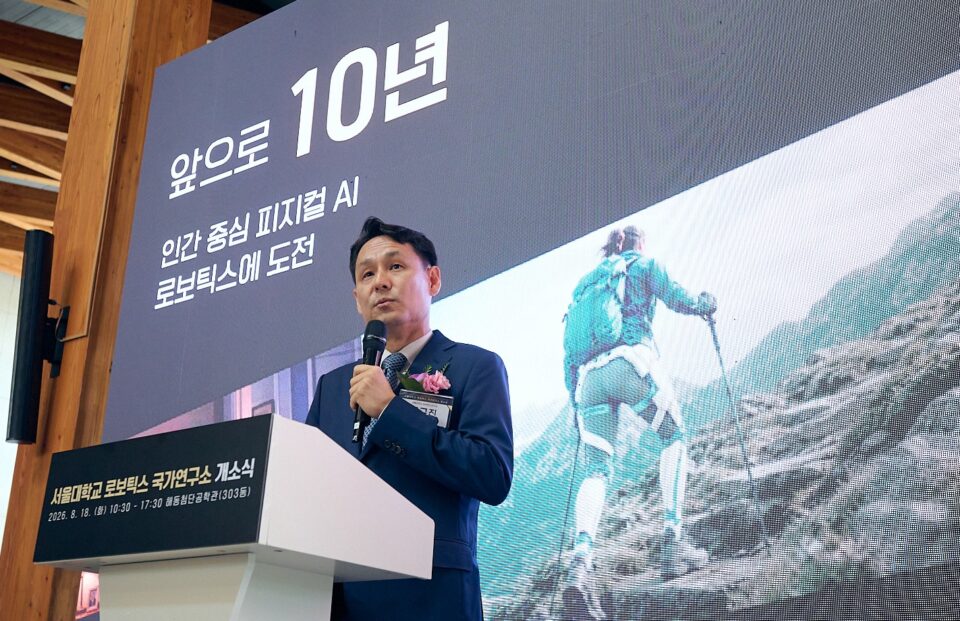
서울대 로보틱스연구소 조규진 소장의 비전 발표 비전발표 영상으로 보기
서울대학교 로보틱스 국가연구소(소장 조규진)가 18일 서울대 해동첨단공학관(303동)에서 개소식을 열고 공식 출범을 알렸다. 이날 행사에는 유홍림 서울대 총장을 비롯해 최형두·정진욱·박민규 의원, 과학기술정보통신부 김성수 연구개발정책실장, 교육부 채홍준 학술연구정책과장, 한국연구재단 박종애 기초연구본부장(직무대행) 등과 로봇 기업인들, 서울대 로보틱스 연구진 등 100여 명이 함께했다.
개소식의 문은 연구소 구성원들이 직접 열었다. 식전 순서 ‘드리머스 토크(Dreamers’ Talk)’에서 교수와 박사후연구원, 창업가, 학부생까지 열두 명이 무대에 올라 로봇으로 이루고 싶은 저마다의 꿈을 발표하며, 연구소의 모토인 “We engineer Dreams to Reality(꿈을 현실로 엔지니어링한다)”의 의미를 관객에게 그대로 전했다. 이어서 조규진 소장이 열세 번째 드리머로 등장해 연구소의 꿈과 비전을 발표했다. 유홍림 총장은 서울대를 대표해 환영사를 한 뒤, 최형두·정진욱·박민규 의원과 김성수 실장, 채홍준 과장, 박종애 본부장(직무대행)이 축사를 전했다.

유홍림 서울대 총장이 로보틱스 연구소 개소식에서 실험용 로봇을 작동해 보고 있다.
조규진 소장은 향후 10년의 연구 방향으로 ‘인간중심 피지컬 AI(Human-centered Physical AI)’를 제시했다. 하나의 AI가 모든 판단을 도맡는 중앙집중형 구조에서 벗어나, 스스로 형태와 강성을 바꾸며 환경에 적응하는 지능적인 몸체와 신체 각 부위가 학습하고 협력하는 분산지능을 결합함으로써, 더 적은 데이터와 에너지로도 현실 세계에서 안전하게 작동하는 로봇을 만들겠다는 구상이다. 이를 위해 연구소는 ‘인간을 대체하는 로봇’을 넘어 ‘인간을 위한 로봇’이라는 철학 아래 일상생활을 지원하는 생활형 로봇(Life Companion), 신체 기능을 보조하고 확장하는 웨어러블 로봇(Wearable), 체내에서 진단과 치료를 수행하는 의료 로봇(Intra-body) 세 분야에 연구 역량을 집중한다.
유홍림 총장은 환영사에서 “대전환의 시대에도 변하지 않는 것이 있다면, 대학은 꿈을 꾸는 사람들의 공간이라는 것”이라며 “젊은 연구자들이 실패를 두려워하지 않고 대담한 질문을 던지며 자신의 꿈을 현실로 만들어가는 학문공동체가 되기를 기대한다”고 밝혔다. 이어 “오늘의 개소식이 한 연구소의 출범을 넘어, 대한민국 로보틱스의 미래를 함께 만들어가는 새로운 협력의 출발점이 되기를 바란다”고 강조했다. 내외빈 축사에 이어 한국연구재단이 국가연구소 지정서를 전달했고, 참석자들이 지켜보는 가운데 연구소 현판 제막식이 거행됐다.
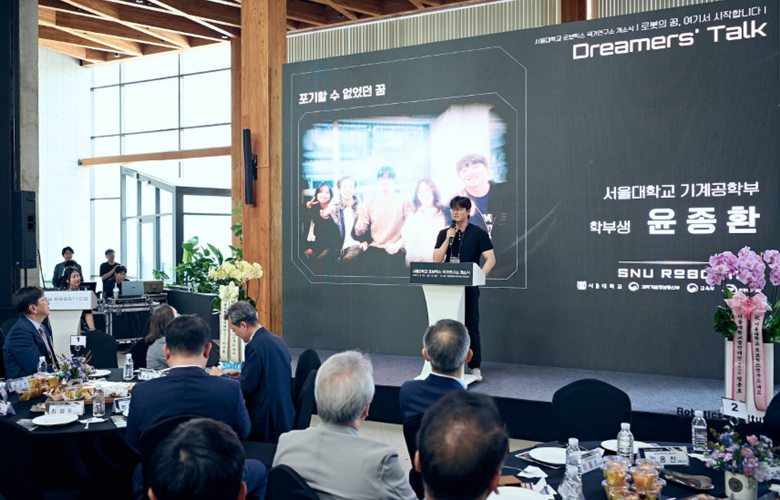
개소식 오프닝 행사인 Dreamers’ Talk에서 발표하고 있는 학생 Dreamers’ Talk 영상으로 보기
현송교육문화재단과의 기부 협약 소식도 이날 공개됐다. 연구소는 국고 지원과 재단 기부를 더해 총 500억 원 규모의 로보틱스 전용 건물을 건립할 계획이다. 조 소장은 “우리가 만들고자 하는 것은 단순히 큰 건물이 아니라, 세계적인 연구자들이 모이고 학생들이 마음껏 로봇을 만들며 연구 성과가 창업과 산업으로 이어지는 살아 있는 생태계”라며 “꿈을 질문으로, 질문을 연구로, 연구를 기술로, 그리고 기술을 현실로 만들겠다”고 말했다.
서울대 로보틱스연구소는 지난 7월 과학기술정보통신부와 교육부가 공동 추진하는 국가연구소(NRL 2.0) 사업에 최종 선정됐다. 첨단기술 분야에서 세계적 경쟁력을 갖춘 대학 부설연구소를 육성하는 범정부 사업으로, 선정 연구소는 최대 10년간 연 110억 원 수준의 연구비와 인프라를 정부와 대학으로부터 지원받는다. 로봇 분야 선정은 서울대 로보틱스연구소가 유일하다. 연구소에는 기계공학·전기정보공학·컴퓨터공학·재료공학 등 공학 분야부터 의학·보건학·뇌인지과학·체육학·의류학·사회과학까지 아우르는 80여 명의 참여·연계 교수가 함께해 서울대 차원의 융합 연구체계를 이룬다. 연구 성과를 산업으로 잇는 창업 체계(Lab-to-Market)도 갖춘다. 서울대기술지주와 함께 창업 펀드와 컴퍼니 빌더를 운영하고 연구소 안에 산학창업지원센터를 설치하며, 서울대학교병원은 웨어러블·의료 로봇의 개발과 임상 플랫폼으로 참여한다. 미국 MIT 미디어랩, 카네기멜론대 로보틱스연구소, 스탠퍼드대, 영국 옥스퍼드대 등 해외 연구기관과 엔비디아(NVIDIA) 등 글로벌 기업과의 공동연구도 추진한다.

뇌인지과학과 이인아 교수가 세미나에서 10년 연구계획을 발표하고 있다.
오후에는 연구소의 연구 역량을 직접 선보이는 ‘미트 SNU 로보틱스(Meet SNU Robotics)’가 참석자들을 맞았다. 최신 로봇 기술의 흐름을 짚는 기술세미나와 로봇 데모가 펼쳐졌고, 00개 연구실이 문을 연 오픈랩에서는 참석자들이 웨어러블 로봇과 수술로봇 등 연구 현장을 직접 둘러보고 체험했다.
조 소장은 “미국과 중국이 각각 소프트웨어와 하드웨어를 주도하는 피지컬 AI 시장에서, 물리지능과 분산지능에 기반한 피지컬 AI는 대한민국이 경쟁력을 확보할 핵심 전략”이라며 “젊은 로봇 연구자들이 실패를 두려워하지 않고 대담한 질문에 도전할 수 있도록 든든한 안전망을 만드는 것이 이 연구소의 중요한 역할”이라고 밝혔다.
- 로봇강국 ‘대한민국의 꿈’을 펼칠 ‘서울대 로보틱스 국가연구소’ 개소 (로봇신문 기사)
- 서울대, ‘사람 위한 로봇’ 만든다…’로보틱스 국가연구소’ 출범 (한국경제)
- 서울대 로보틱스연구소 개소.. 인간중심 로봇 만든다 (조선일보)
- 로보틱스 국가연구소 (조선TV 동영상보기)
SNU Robotics Institute Celebrates Its Official Opening
- Opening ceremony held at the Haedong Advanced Engineering Building, with some 100 guests from Korea and abroad
- A ten-year commitment to Human-centered Physical AI under the philosophy of “robots for humans”
- “A safety net for young researchers pursuing bold robotics research and entrepreneurship”
The Seoul National University (SNU) Robotics Institute (Director Kyu-Jin Cho) held its opening ceremony on August 18 at the Haedong Advanced Engineering Building (Building 303) on the SNU campus, marking its official launch. Around 100 guests attended, including SNU President Honglim Ryu; National Assembly members Choi Hyung-doo, Jung Jin-wook, and Park Min-kyu; Sung Soo Kim, Deputy Minister of the Office of R&D Policy at the Ministry of Science and ICT; Chae Hong-jun, Director of the Academic Research Policy Division at the Ministry of Education; Park Jong-ae, Acting Head of the Directorate for Basic Research in Science & Engineering at the National Research Foundation of Korea; along with robotics entrepreneurs and SNU robotics researchers.
The ceremony opened with the Institute’s own members taking the stage. In the pre-ceremony program “Dreamers’ Talk,” twelve speakers — professors, postdoctoral researchers, entrepreneurs, and undergraduates — each shared the dream they hope to realize through robotics, bringing to life the Institute’s motto, “We engineer Dreams to Reality.” Director Kyu-Jin Cho then appeared as the thirteenth dreamer to present the Institute’s dream and vision. President Honglim Ryu delivered a welcoming address on behalf of the university, followed by congratulatory remarks from Assembly members Choi Hyung-doo, Jung Jin-wook, and Park Min-kyu, Deputy Minister Kim, Director Chae Hong-jun, and Acting Head Park Jong-ae.
Director Cho presented “Human-centered Physical AI” as the Institute’s research direction for the next ten years. Moving beyond a centralized architecture in which a single AI makes every decision, the vision combines an intelligent body that adapts to its environment by changing its own shape and stiffness with distributed intelligence in which each part of the body learns and cooperates — creating robots that operate safely in the real world with less data and less energy. To this end, under the philosophy of “robots for humans” rather than “robots replacing humans,” the Institute will concentrate its research capabilities on three areas: Life Companion robots that support daily living, Wearable robots that assist and augment bodily functions, and Intra-body medical robots that perform diagnosis and treatment inside the human body.
In his welcoming address, President Ryu said, “If there is one thing that does not change even in an era of great transformation, it is that the university is a space for those who dream. I hope this will be an academic community where young researchers, unafraid of failure, ask bold questions and turn their dreams into reality.” He added, “May today’s ceremony mark not merely the launch of one institute, but the starting point of a new partnership in shaping the future of Korean robotics together.” Following the congratulatory remarks, the National Research Foundation of Korea presented the National Research Laboratory designation certificate, and the Institute’s plaque was unveiled before the assembled guests.
The ceremony also brought news of a donation agreement with the Hyunsong Educational & Cultural Foundation. Combining government funding with the Foundation’s gift, the Institute plans to construct a dedicated robotics building at a total cost of approximately USD 36 million (KRW 50 billion). “What we want to build is not simply a large building,” Director Cho said, “but a living ecosystem where world-class researchers gather, students build robots to their heart’s content, and research outcomes translate into new startups and industrial applications. We will turn dreams into questions, questions into research, research into technology, and technology into reality.”
The SNU Robotics Institute was selected in July for the National Research Laboratory (NRL 2.0) program, jointly administered by the Ministry of Science and ICT and the Ministry of Education. Under this pan-governmental program to foster university-affiliated research institutes with world-class competitiveness in advanced technology fields, selected institutes receive research funding of approximately USD 8 million (KRW 11 billion) per year, along with research infrastructure, from the government and the university for up to ten years. The SNU Robotics Institute is the only institute selected in the field of robotics. More than 80 participating and affiliated professors — spanning mechanical engineering, electrical and computer engineering, computer science, and materials science, as well as medicine, public health, brain and cognitive sciences, kinesiology, textiles and clothing science, and the social sciences — form a university-wide interdisciplinary research framework. The Institute is also building a Lab-to-Market system that connects research outcomes to industry: it will operate a startup investment fund and a company builder with SNU Holdings and establish an industry-academia startup support center within the Institute. Seoul National University Hospital will serve as a platform for the development and clinical evaluation of wearable and medical robots. Joint research is also planned with leading institutions abroad — including the MIT Media Lab, the Robotics Institute at Carnegie Mellon University, Stanford University, and the University of Oxford — and with global companies such as NVIDIA.
In the afternoon, guests were invited to “Meet SNU Robotics,” a showcase of the Institute’s research capabilities. Technical seminars traced the latest trends in robotics alongside live robot demonstrations, and 35 laboratories opened their doors for an open-lab tour where guests explored and experienced research firsthand, from wearable robots to surgical robots.
“In a physical AI market where the U.S. and China lead in software and hardware respectively, physical AI grounded in physical intelligence and distributed intelligence is a key strategy for Korea to secure its competitive edge,” Director Cho said. “An important role of this institute is to build a strong safety net so that young robotics researchers can pursue bold research questions without fearing failure.”