
- 최대 10년간 장기 지원…피지컬 AI 연구와 로봇 창업 생태계 구축
- 로봇의 몸과 지능을 함께 설계하는 새로운 피지컬 AI 패러다임 제시
- 미·중이 주도하는 로보틱스 시장의 미래 판도를 바꿀 원천기술 될 것
- 로보틱스 연구자의 창업을 지원하는 ‘Lab-to-Market’의 거점으로 기능
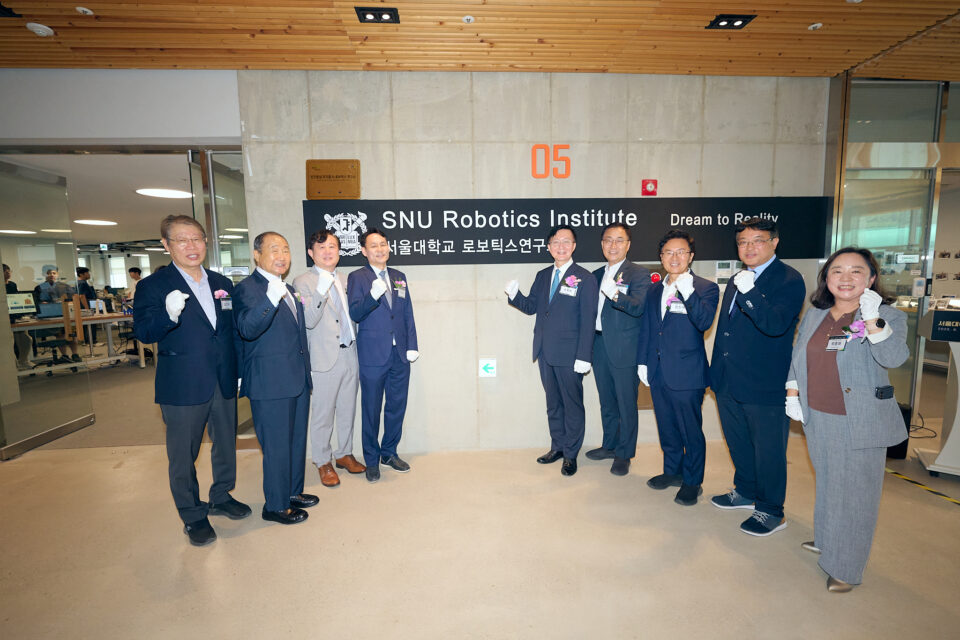
서울대 로보틱스연구소 현판 제막식에는 국가연구소(NRL 2.0) 사업을 지원하는 과기정통부의 김성수 연구개발정책실장, 교육부의 채홍준 학술연구정책과장, 한국연구재단의 박종애 기초연구본부장 직무대행 등이 참석하였다.
서울대학교 로보틱스연구소(소장 조규진)가 과학기술정보통신부와 교육부가 공동 추진하는 2026년 국가연구소 사업에 최종 선정됐다. 연구소는 앞으로 최대 10년간 정부 지원을 바탕으로 로봇의 몸과 지능을 함께 설계하는 차세대 피지컬 AI 원천기술 개발과 창업 생태계 구축을 추진한다.
국가연구소 사업(NRL 2.0)은 세계와 경쟁하고 지역과 상생할 수 있는 역량을 지닌 대학 부설연구소를 선정해, 첨단기술 분야에서 글로벌 경쟁력을 갖춘 연구소로 육성하는 범정부 차원의 연구지원 사업이다. 선정된 연구소는 최대 10년간 연 110억 원 수준의 연구비와 연구 인프라를 정부와 대학으로부터 지원받는다.
서울대 로보틱스연구소는 이번 사업을 통해 기존 로봇 하드웨어와 중앙집중형 인공지능이 지닌 한계를 극복할 새로운 피지컬 AI 패러다임을 제시하고, 이를 구현할 핵심 원천기술을 개발한다. 하나의 AI가 모든 판단을 수행하는 중앙집중형 구조에서 벗어나, 로봇의 각 부위가 필요한 정보를 현장에서 직접 처리하고 상위 AI와 협력하는 분산지능 기술이 핵심이다. 여기에 임무와 환경에 따라 형태와 기능을 유연하게 바꾸는 모듈형 재구성 기술, 생명체의 구조와 원리를 활용해 환경에 적응하는 생체모사 기술도 함께 연구한다.
연구소는 하드웨어 플랫폼인 ‘MORPHI Body’와 분산지능 플랫폼인 ‘MOSAIC Intelligence’를 기반으로, 클라우드 기반 AI의 연산 부담과 시간 지연을 줄이고, 로봇이 스스로 환경에 적응하는 지능형 하드웨어 기술을 구현할 계획이다. 이와 함께 인간중심 가치를 로봇 설계 단계에서부터 반영하고 측정·검증하는 연구를 병행한다. 나아가 인간의 감각·운동 신경계를 모사한 체화된 물리 지능과 분산지능을 결합해, 초개인화 로봇 서비스와 제조혁신, 서비스형 로봇(RaaS) 확산을 이끌고 초고령사회 삶의 질 향상에도 기여하는 것을 목표로 한다.
연구소는 ‘인간을 대체하는 로봇’을 넘어 ‘인간을 위한 로봇’이라는 철학 아래 ▲일상생활을 지원하는 생활형 로봇(Life Companion) ▲신체 기능을 보조·확장하는 웨어러블 로봇(Wearable) ▲체내에서 진단과 치료를 수행하는 의료 로봇(Intra-body) 등 세 분야를 중심으로 인간중심 피지컬 AI(Human-centered Physical AI) 연구를 추진한다.
이를 위해 기계공학, 전기정보공학, 컴퓨터공학, 재료공학 등 공학 분야는 물론 의학, 보건학, 뇌인지과학, 체육학, 의류학, 사회과학까지 아우르는 참여·연계 교수 80여 명이 함께하는 서울대 차원의 융합 연구체계를 구축한다. 특히 서울대학교병원은 웨어러블 로봇과 의료 로봇의 개발과 실험, 융합 연구자 양성에 적극 관여하며, 상용화 단계에서 임상 플랫폼으로 기능할 예정이다. 미국 MIT Media Lab, 카네기멜론대 로보틱스연구소(RI), 스탠퍼드대, 영국 옥스퍼드대 등 해외 연구기관과 엔비디아(NVIDIA) 등 글로벌 기업과의 공동연구도 추진한다. 나아가 서울대학교가 구축한 글로벌 빅테크 자산 및 인프라를 적극 결합하여 차세대 물리 제어 모델 라이브러리 구축 및 국제 표준 선점 프로세스도 동시에 밟아 나간다.
서울대 로보틱스연구소는 연구성과를 산업으로 연결하는 창업 체계(Lab-to-Market) 구축에 적극 나서 로보틱스 창업의 거점 역할을 맡을 계획이다. 이를 위해 서울대기술지주와 협력해 창업 펀드와 컴퍼니 빌더를 운영하고, 연구성과의 사업화 및 창업을 지원하기 위한 산학창업지원센터를 연구소 내에 설치한다.
조규진 소장은 “미국과 중국이 각각 소프트웨어와 하드웨어를 주도하는 피지컬 AI 시장에서 물리지능과 분산지능 기반 피지컬 AI는 대한민국이 경쟁력을 확보할 수 있는 핵심 전략이 될 것“이라며 “소재와 구조 자체의 물리적 지능을 활용해 비용과 연산량을 획기적으로 낮추고, 인간의 능력을 확장하는 로봇을 보급함으로써 초고령사회 돌봄 안전망 구축과 인류의 삶의 질 향상에 기여하는 세계 최고 수준의 지식공동체를 완성하겠다“고 포부를 밝혔다.
관련기사: 서울대 로보틱스연구소, 국가연구소 사업 최종 선정
SNU Robotics Institute Selected as a National Research Laboratory (NRL 2.0), Building a Hub for Physical AI Research
- Long-term government support for up to 10 years to advance physical AI research and build a robotics startup ecosystem
- A new physical AI paradigm that co-designs the robot’s body and intelligence
- Foundational technologies poised to reshape the future of a robotics market now led by the U.S. and China
- A “Lab-to-Market” hub supporting robotics researchers on the path to entrepreneurship
The Seoul National University (SNU) Robotics Institute (Director Kyu-Jin Cho) has been selected for the 2026 National Research Laboratory program, jointly administered by the Ministry of Science and ICT and the Ministry of Education. With government support for up to ten years, the Institute will develop foundational technologies for next-generation physical AI — co-designing the robot’s body and intelligence — and build a robotics startup ecosystem.
The National Research Laboratory program (NRL 2.0) is a pan-governmental initiative that selects university-affiliated research institutes capable of competing globally and contributing locally, and supports their development into world-class research institutions in advanced technology fields. Selected institutes receive research funding of approximately USD 8 million (KRW 11 billion) per year, along with research infrastructure, from the government and the university for up to ten years.
Through the program, the SNU Robotics Institute will propose a new physical AI paradigm that overcomes the limitations of conventional robot hardware and centralized AI, and will develop the foundational technologies to realize it. Moving beyond a centralized architecture in which a single AI makes every decision, the key is distributed intelligence: each part of the robot processes the information it needs on site and cooperates with a higher-level AI. The Institute will also research modular reconfiguration technology, which flexibly changes a robot’s form and function to suit its task and environment, and biomimetic technology, which draws on the structures and principles of living organisms to adapt to the environment.
Building on its hardware platform, MORPHI Body, and its distributed intelligence platform, MOSAIC Intelligence, the Institute plans to reduce the computational burden and latency of cloud-based AI and realize intelligent hardware that allows robots to adapt to their environment on their own. In parallel, the Institute will conduct research to embed human-centered values from the design stage and to assess and validate how well these values are reflected in robot design. By combining embodied physical intelligence modeled on the human sensory-motor nervous system with distributed intelligence, the Institute aims to drive hyper-personalized robot services, manufacturing innovation, and the spread of Robots-as-a-Service (RaaS), while contributing to quality of life in a super-aged society.
Under the philosophy of “robots for humans” rather than “robots replacing humans,” the Institute will pursue Human-centered Physical AI research in three focus areas: Life Companion robots that support daily living, Wearable robots that assist and augment bodily functions, and Intra-body medical robots that perform diagnosis and treatment inside the human body.
To this end, the Institute will establish a university-wide interdisciplinary research framework involving more than 80 participating and affiliated professors, spanning engineering fields such as mechanical engineering, electrical and computer engineering, computer science, and materials science, as well as medicine, public health, brain and cognitive sciences, kinesiology, textiles and clothing science, and the social sciences. Seoul National University Hospital, in particular, will take an active role in developing and testing wearable and medical robots and in training researchers to work across disciplines, and will serve as a clinical platform at the commercialization stage. The Institute will also pursue joint research with leading institutions abroad — including the MIT Media Lab, the Robotics Institute at Carnegie Mellon University, Stanford University, and the University of Oxford — and with global companies such as NVIDIA. Furthermore, by leveraging the global big-tech assets and infrastructure that Seoul National University has built, the Institute will simultaneously develop a next-generation physical control model library and seek a leading role in shaping international standards.
The SNU Robotics Institute will also actively build a Lab-to-Market system that connects research outcomes to industry, serving as a hub for robotics entrepreneurship. In partnership with SNU Holdings, it will operate a startup investment fund and a company builder, and will establish an industry-academia startup support center within the Institute to support commercialization and new ventures.
“In a physical AI market where the U.S. and China lead in software and hardware respectively, physical AI grounded in physical intelligence and distributed intelligence will be a key strategy for Korea to secure its competitive edge,” said Director Kyu-Jin Cho. “By harnessing the physical intelligence inherent in materials and structures to dramatically cut cost and computation, and by bringing robots that extend human capabilities into wide use, we will build a world-class knowledge community that helps establish a care safety net for a super-aged society and improves quality of life for humanity.”